


Insights and Analysis: Mortgage and Real Estate Capital Markets Update with Jeff Rosato, SVP of Capital Markets at Nationwide Mortgage Bankers.
Key Takeaways
Mortgage rates moved higher for the third consecutive week as inflation concerns, elevated oil prices, and ongoing geopolitical tensions continued to pressure financial markets. The Federal Reserve remains focused on combating persistent inflation while balancing resilient economic growth and a stable labor market. Investors are closely watching this week’s key inflation reports, including CPI and PPI data, as well as additional Federal Reserve commentary for signals on the future direction of interest rates, Treasury yields, and mortgage pricing.
Here’s a look at this week’s update on the major bond market indices, scheduled Federal Reserve meetings, upcoming market-moving economic data releases, and general bond market trends.
Bond Market Indices
“Elevated oil prices as a result of the war in Iran are feeding directly into broad inflation expectations, and that has put the Fed policymakers in a “higher for longer” stance as it relates to interest rate cuts.”
Market Overview and Rate Trends
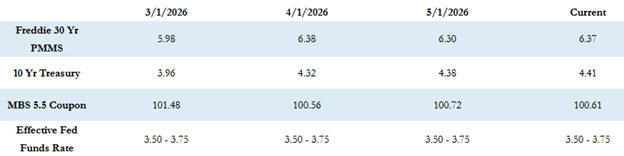
The Freddie Mac average 30-year fixed rate was 6.37% as of last Thursday, rising by 7 basis points compared to the prior week. That puts the max APR this week for 30-year fixed-rate loans at roughly 7.87% (6.37 + 1.50).
The 10-year Treasury yield closed last week at 4.36%, down approximately 1 basis point for the week.
Over the last several weeks, financial markets have been driven by geopolitical risks, inflation concerns tied to elevated oil and energy prices, and the Federal Reserve’s ongoing balancing act between persistent inflation and resilient economic data.
Federal Reserve Policy & Inflation Outlook
Last week’s labor market data showed stronger-than-expected job growth for the second consecutive month, with 115,000 jobs added in April while the unemployment rate remained steady at 4.3%.
The Federal Reserve has become increasingly focused on inflation concerns rather than labor market weakness. Elevated oil prices resulting from the war in Iran are feeding directly into broader inflation expectations, reinforcing the Fed’s “higher for longer” approach to interest rate policy.
While future rate cuts may still occur eventually, the Fed has signaled that it is in no rush to begin easing monetary policy. As inflation pressures have intensified, Treasury yields have moved higher and mortgage rates have followed suit. Mortgage rates have now increased for three consecutive weeks, impacting refinance activity, while purchase demand has remained relatively steady during the spring homebuying season.
Economic Calendar & Market Drivers
The economic calendar is especially active this week, with several major inflation reports scheduled for release.
There are also numerous Federal Reserve speaking engagements scheduled throughout the week, as governors and regional presidents continue elaborating on the strategy and policy decisions from the most recent FOMC meeting.
Despite fresh inflation data and additional Fed commentary, market movement is still expected to be heavily influenced by oil prices and ongoing uncertainty surrounding the conflict in Iran.
Current Market Conditions
MBS prices are worse by approximately 15–25 basis points compared to Friday’s close, and the 10-year Treasury yield is up by about 5 basis points to 4.41%.
Looking Ahead
Markets are expected to remain highly sensitive to inflation data, Federal Reserve commentary, geopolitical developments, and energy prices in the weeks ahead. With volatility continuing across both the bond and mortgage markets, staying informed and prepared to respond quickly to changing conditions will remain critical for both borrowers and industry professionals alike.