



Insights and Analysis: Mortgage and Real Estate Capital Markets Update with Jeff Rosato, SVP of Capital Markets at NMB Now.
Key Takeaways
Mortgage rates edged higher last week as markets continued to balance easing inflation data against resilient economic growth and ongoing geopolitical uncertainty. While recent Consumer Price Index (CPI) and Producer Price Index (PPI) reports came in softer than expected, strong employment, retail sales, and manufacturing data suggest the U.S. economy remains on solid footing. Investors are now focused on next week’s Federal Open Market Committee (FOMC) meeting, with markets expecting the Federal Reserve to hold rates steady while monitoring inflation trends and global developments that could influence future monetary policy.
Here’s a look at this week’s update on the major bond market indices, scheduled Federal Reserve meetings, upcoming market-moving economic data releases, and general bond market trends.
Bond Market Indices
“Economic data has continued to show exceptional resilience with weekly jobless claims, retail sales, and manufacturing data all stronger than expected. The data reinforces the fact that inflation is easing without meaningful deterioration in economic activity.”
Market Overview and Rate Trends
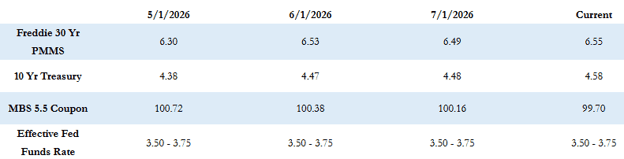
The Freddie Mac average 30-year fixed mortgage rate increased to 6.55% as of last Thursday, rising 6 basis points from the previous week. Based on that average, the maximum Annual Percentage Rate (APR) for a 30-year fixed-rate loan is approximately 8.05% (6.55% + 1.50%).
Meanwhile, the 10-year Treasury yield closed last week at 4.54%, declining slightly by approximately 3 basis points from the prior week.
Inflation, Geopolitics, and Federal Reserve Outlook
Geopolitical headlines and energy prices remained key drivers of market sentiment last week as renewed tensions in the Middle East continued to introduce volatility across financial markets.
Both the Consumer Price Index (CPI) and Producer Price Index (PPI) reports surprised to the downside. Most notably, the headline CPI reading came in at -0.4% month over month, signaling softer inflation than economists had anticipated. However, annual inflation remains above the Federal Reserve’s long-term 2% target, and ongoing geopolitical tensions continue to create upward pressure on energy prices. As a result, many economists believe the recent weakness in inflation data may prove temporary.
Oil prices retreated late in the week, helping support a modest rally in the bond market.
At the same time, broader economic data continued to demonstrate exceptional resilience. Weekly jobless claims, retail sales, and manufacturing reports all exceeded expectations, reinforcing the view that inflation is moderating without a significant slowdown in economic activity.
This combination of easing inflation and continued economic strength aligns with the Federal Reserve’s current “wait-and-see” approach to monetary policy. Most economists now expect the Fed to leave interest rates unchanged at next week’s FOMC meeting. Looking ahead, however, futures markets are currently pricing in approximately a 65% probability of a 0.25% rate hike at the September meeting, though those expectations could shift quickly as new economic data and geopolitical developments emerge.
Economic Calendar and Market Drivers
While market volatility is expected to remain elevated, this week’s economic calendar is relatively light.
The Federal Reserve Board of Governors began a two-day closed meeting earlier this week. Outside of that, investors will primarily focus on weekly jobless claims and new home sales for additional insight into the health of the U.S. economy.
With limited economic data scheduled for release, markets may remain especially sensitive to geopolitical developments and any unexpected comments from Federal Reserve officials.
Current Market Conditions
Mortgage-backed securities (MBS) are down approximately 25 to 30 basis points compared to Friday’s close, while the 10-year Treasury yield has moved slightly higher to 4.59%.
Looking Ahead
Markets continue to navigate the intersection of moderating inflation, resilient economic growth, Federal Reserve policy expectations, and geopolitical uncertainty. As investors prepare for next week’s FOMC meeting, incoming economic data and global events will remain critical in shaping the outlook for interest rates and mortgage markets.
Stay tuned each week as we continue providing timely insights into the economic trends, bond markets, and mortgage rate movements that matter most to homebuyers, homeowners, and real estate professionals.


