


Insights and Analysis: Mortgage and Real Estate Capital Markets Update with Jeff Rosato, SVP of Capital Markets at NMB NOW.
Key Takeaways
Mortgage rates have climbed sharply in recent weeks, with the Freddie Mac average 30-year fixed mortgage rate reaching 7.28%, its highest level since November 2023. The 10-year Treasury yield has also risen to 5.28%, reflecting continued inflation concerns, elevated oil and energy prices, and uncertainty surrounding Federal Reserve policy. At the same time, recent employment data showed signs of weakening in the labor market, creating a more complicated outlook for interest rates and the broader economy. While a softer labor market could eventually provide relief for mortgage rates and bond markets, inflation remains the Federal Reserve’s primary concern. Mortgage lenders, loan officers, borrowers, and real estate professionals should remain prepared for continued volatility as markets digest upcoming economic data and Federal Reserve commentary.
Here’s a look at this week’s update on the major bond market indices, scheduled Federal Reserve meetings, upcoming market-moving economic data releases, and general bond market trends.
Bond Market Indices
“If weakening labor market conditions drive a broader slowdown in economic growth then we should see sustained relief in the bond markets, but for now the Fed’s main focus remains on inflation and the price pressures facing the economy that have been driven by high oil/energy costs as a result of the conflict in Iran.”
Mortgage Rate and Treasury Market Trends
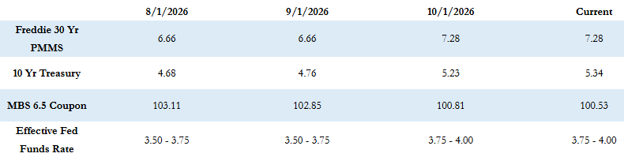
Mortgage rates have remained elevated through the end of September and into October, reaching their highest levels since November 2023. The Freddie Mac average 30-year fixed rate is at 7.28% and was up sharply by 25 basis points compared to the prior week. Since the beginning of September, the index has increased by 0.62%, from 6.66%, which has been a very sharp move in a short period of time. That puts the maximum APR this week for 30-year fixed-rate loans at roughly 8.78% (7.28% + 1.50). The 10-Year Treasury yield closed at 5.28%, up 10 basis points over the most recent reporting period.
Rates have risen dramatically recently and have done so in a very short period of time. When this occurs, it can cause some dislocation in the MBS market. Investors tend to price conservatively when security prices turn dramatically lower as rates spike.
Despite agencies and correspondent investors opening up higher note rates in the 7.0% coupon range, including 7.75% note rates and above, pricing on those higher rates is not great, and most scenarios would still come with the borrower paying some discount points. Over time, as volume flows into the higher coupons, premiums should improve.
Employment Data and Federal Reserve Outlook
The September U.S. employment report came in well below the market expectation of an increase of 89,000 jobs, with only 39,000 jobs added. In addition, there were substantial downward revisions to prior months’ numbers, and the unemployment rate ticked up to 4.2% versus the expectation of 4.1%.
Following the release, the bond markets rallied slightly, although the rally fizzled and has not been sustained. If weakening labor market conditions drive a broader slowdown in economic growth, then we should see sustained relief in the bond markets. For now, however, the Fed’s main focus remains on inflation and the price pressures facing the economy that have been driven by high oil and energy costs as a result of the conflict in Iran.
The U.S. economy has shown enough resilience that the Fed feels economic growth can withstand the tighter inflation-fighting policy stance. The economy may be strong enough overall to justify the Fed’s rate hike in September, but further tightening through the end of the year risks putting additional pressure on a labor market that is beginning to show signs of weakness.
The Fed will continue to be dependent on fresh data to shape its strategy going forward. The current probability for another 0.25% rate hike by the Fed at the conclusion of its October FOMC meeting stands at about 25%.
Housing Affordability and Market Conditions
The current rate environment is challenging for borrowers and lenders. Total mortgage applications were down by about 6% week over week, and refinance activity is down by over 50% compared to a year ago.
Housing prices have remained elevated, and combined with higher mortgage rates, borrowers are facing harsh affordability issues. The combination of higher borrowing costs and elevated home prices continues to put pressure on prospective homebuyers and existing homeowners considering a refinance.
Economic Calendar and Bond Market Outlook
The economic calendar is fairly light this week, but the minutes from the Federal Reserve’s September meeting are scheduled for release, along with several Federal Reserve speaking engagements.
So far, MBS prices are down by about 25 basis points compared to their most recent close, and the 10-Year Treasury yield is up sharply by about 6 basis points to 5.34%.
Looking Ahead
Mortgage rates and Treasury yields remain under pressure as markets balance persistent inflation, elevated energy prices, weakening labor-market indicators, and the Federal Reserve’s next policy moves. While signs of labor-market weakness could eventually provide relief for the bond market, inflation remains the key factor shaping the Fed’s outlook. For loan officers and real estate professionals, staying informed and proactively managing active pipelines will be critical as mortgage rates and market conditions continue to evolve.
Stay tuned each week for the latest insights from Jeff Rosato on mortgage rates, the bond market, Federal Reserve policy, and the economic forces shaping the housing market.


