



Insights and Analysis: Mortgage and Real Estate Capital Markets Update with Jeff Rosato, SVP of Capital Markets at NMB NOW.
Key Takeaways
Mortgage rates eased following a bond market rally, with the Freddie Mac 30-year fixed rate falling to 7.24% and the 10-Year Treasury yield declining to 4.88%. The Federal Reserve held its benchmark rate at 3.75%–4.00%, but markets are pricing in a 75% chance of another increase in December. Persistent inflation, elevated oil prices, and economic uncertainty continue to influence the outlook, while upcoming employment data will provide further insight into the direction of interest rates.
Here’s a look at this week’s update on the major bond market indices, scheduled Federal Reserve meetings, upcoming market-moving economic data releases, and general bond market trends.
Bond Market Indices
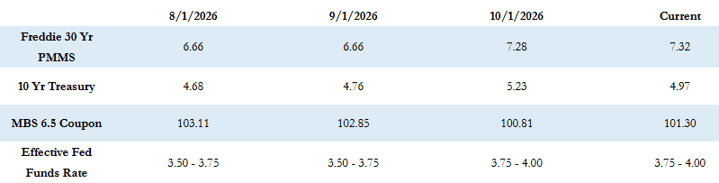
“As expected last week the Federal Reserve FOMC left its benchmark Fed Funds Rate at the current range of 3.75-4.0%. However, there is a high probability that the committee will agree on a rate hike at their next decision meeting on December 9th.”
Mortgage Rate and Treasury Market Trends
The Freddie Mac average 30-year fixed mortgage rate stands at 7.24%, down 8 basis points compared to the previous week. Although mortgage rates have decreased toward the end of October from their recent highs, the PMMS at 7.24% is still approximately 0.50 percentage points higher than where rates were at the beginning of September.
Based on the current average rate, the maximum APR for 30-year fixed-rate loans this week is approximately 8.74% (7.24% + 1.50%).
The 10-Year Treasury yield closed the latest reporting period at 4.93%, down 6 basis points for the week. Current market activity shows the 10-Year Treasury yield declining further to approximately 4.88%.
These movements reflect some improvement in the bond markets over the past couple of weeks. However, the broader interest rate environment remains challenging, and mortgage rates continue to be influenced by inflation expectations, economic conditions, and geopolitical developments.
Federal Reserve Policy and Interest Rate Outlook
As expected, the Federal Reserve’s Federal Open Market Committee (FOMC) left its benchmark federal funds rate unchanged within the current range of 3.75%–4.00%. However, there is a high probability that the committee will agree on another rate increase at its next policy decision meeting on December 9.
Currently, federal funds futures markets are pricing in approximately a 75% chance of a 0.25-percentage-point rate increase in December.
Inflation remains elevated above the Fed’s 2% target, economic growth continues to demonstrate resilience, and oil prices remain volatile and elevated due to the conflict with Iran. The risks associated with persistent elevated inflation currently outweigh the potential risks to employment and economic growth that could result if the Fed continues tightening monetary policy.
The recent rally in the bond markets over the past two weeks has not been driven by any fundamental change in inflation expectations or weakening economic conditions in the United States. Instead, other factors, including weakness in the stock markets and safe-haven demand amid a dynamic geopolitical environment, have contributed to the movement.
Even so, it appears that mortgage rates peaked in early October during this latest cycle. The Federal Reserve and market participants will continue to rely on incoming economic data to shape interest rate expectations through the end of the year and into next year.
Economic Data and Federal Reserve Outlook
The upcoming economic calendar is heavily focused on employment data, with several important reports scheduled for release.
The October ADP Employment Report, Weekly Jobless Claims, and the official October U.S. Employment Report will provide additional insight into labor market conditions. Current expectations are for 55,000 jobs to have been added in October, with the unemployment rate remaining steady at 4.2%.
In addition to the employment reports, several Federal Reserve officials are scheduled to speak, and the markets will be looking for further clarification on the latest interest rate decision and the Fed’s strategy moving forward.
Midterm congressional elections took place across the United States. However, the election results are not expected to have any immediate impact on the financial markets or the overall economic outlook.
These upcoming economic releases and Federal Reserve communications will be important in determining whether inflationary pressures continue to support tighter monetary policy or whether changing economic conditions could influence the Fed’s approach.
Bond Market Outlook
The bond markets have continued to show signs of improvement, although the broader economic environment remains uncertain.
Mortgage-backed securities (MBS) prices are currently up approximately 15–20 basis points compared to their most recent close, while the 10-Year Treasury yield has declined approximately 5 basis points to 4.88%.
Market participants will continue monitoring employment data, inflation trends, economic growth, geopolitical developments, and Federal Reserve communications for signals about the direction of interest rates. These factors will remain central to mortgage pricing and market volatility in the weeks ahead.
Looking Ahead
Mortgage rates have shown some improvement following the recent bond market rally, but persistent inflation, elevated oil prices, and uncertainty surrounding future Federal Reserve policy continue to create challenges for the mortgage and real estate markets. The upcoming employment reports and additional commentary from Federal Reserve officials will provide important insight into the economic outlook and the potential direction of interest rates.
As economic conditions continue to evolve, staying informed on bond market movements, inflation trends, and Federal Reserve policy remains essential to understanding the factors influencing mortgage rates and housing affordability.
Stay tuned to NMBNOW® for Jeff Rosato’s weekly market insights and the latest developments shaping mortgage rates, capital markets, and the real estate industry.


