


Insights and Analysis: Mortgage and Real Estate Capital Markets Update with Jeff Rosato, SVP of Capital Markets at NMB NOW.
Key Takeaways
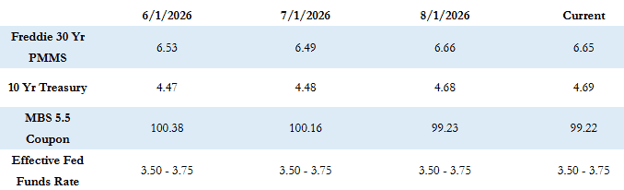
Mortgage rates remain elevated as investors continue to weigh softer economic data, easing inflation pressures, Federal Reserve interest rate expectations, and ongoing geopolitical tensions in the Middle East. The Freddie Mac average 30-year fixed mortgage rate declined slightly to 6.65%, while the 10-year Treasury yield ended last week at 4.73%. Recent retail sales, employment, and inflation data have reinforced expectations that the Federal Reserve may hold rates steady at its September FOMC meeting, while markets continue to assess the possibility of a rate hike later this year. This week, housing data, second-quarter GDP, and the PCE Price Index will be key market drivers for mortgage rates, Treasury yields, and the broader bond market.
Here’s a look at this week’s update on the major bond market indices, scheduled Federal Reserve meetings, upcoming market-moving economic data releases, and general bond market trends.
Bond Market Indices
“Recent soft economic data including July’s retail sales, lower payrolls, and easing inflation data have reinforced the expectation that the Fed will hold rates steady at their September FOMC meeting on 9/16.”
Market Overview and Rate Trends
Mortgage rates have been steadily on the rise over the last few weeks. The Freddie Mac average 30-year fixed rate is at 6.65% as of last Thursday and was down slightly by 2 basis points compared to the prior week. That puts the maximum APR this week for 30-year fixed-rate loans at roughly 8.15% (6.65% + 1.50%).
The 10-year Treasury yield closed last week at 4.73%, which was up by 3 basis points for the week.
Federal Reserve Outlook
Recent soft economic data, including July’s retail sales, lower payrolls, and easing inflation data, have reinforced the expectation that the Fed will hold rates steady at its September FOMC meeting on 9/16.
Current odds for a rate hike at that meeting are at about 30%, down from about 60% approximately a month ago. Unless new inflation or employment data released between now and then materially change the outlook, it appears likely that any rate hike will not come before October.
Fed futures markets currently imply odds of about a 55% chance for a rate hike in October.
Last week, the minutes from the July FOMC meeting were released and reiterated that inflation remains the Fed’s key policy constraint, while the risk of renewed inflation due to higher oil prices remains. Many of the FOMC committee members favor new rate hikes if the easing in inflation data stalls.
Treasury Market Developments
Also last week, the Trump administration announced that the Treasury would commence its buyback of Treasury bonds on the long end of the yield curve to help push longer-term yields down.
The announcement sparked a brief rally in the bond markets but quickly fizzled, as the longer-term effects of the buybacks are not expected to have a material impact on shorter-term rates and/or mortgage rates.
Economic Calendar and Market Drivers
This week, the economic calendar is fairly busy with the release of the Case-Shiller Home Price Index and New Home Sales.
The two most important releases of the week will be the first look at 2026 Q2 GDP and the PCE Price Index, which is the Fed’s preferred inflation gauge.
The PCE Index is expected to show continued easing in underlying price pressures, but any surprise to the high side could spark a bond market sell-off and renewed calls for a rate hike in September.
Geopolitical Risks and Market Volatility
The war in Iran continues to be a key driver in the direction of the financial markets, and volatility will remain in the markets until geopolitical tensions ease and energy prices stabilize.
Current Market Conditions
MBS prices are up slightly by about 10–15 basis points compared to where they closed on Friday, and the 10-year Treasury is down a few basis points to 4.70%.
Looking Ahead
Mortgage and bond markets remain sensitive to economic growth, inflation trends, Federal Reserve policy expectations, and geopolitical developments. With housing data, second-quarter GDP, and the PCE Price Index all in focus this week, investors will be watching closely for signs that could influence the next move in Treasury yields and mortgage rates.
Stay tuned each week for the latest insights on mortgage rates, inflation, Federal Reserve policy, economic data, and the market trends shaping the housing and real estate landscape.