



Insights and Analysis: Mortgage and Real Estate Capital Markets Update with Jeff Rosato, SVP of Capital Markets at NMB NOW.
Key Takeaways
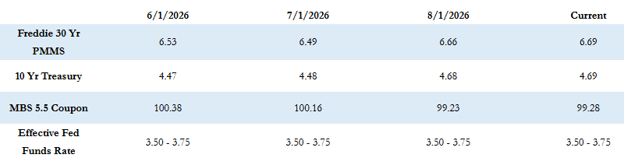
Mortgage rates remain elevated as geopolitical tensions in the Middle East, higher oil prices, inflation concerns, and shifting Federal Reserve expectations continue to drive volatility across the bond and mortgage markets. The Freddie Mac average 30-year fixed mortgage rate increased to 6.69%, while the 10-year Treasury yield closed the week at 4.66%. This week, investors will closely watch the latest Consumer Price Index (CPI) and Producer Price Index (PPI) reports for additional insight into inflation and the Federal Reserve’s future interest rate decisions. With inflation risks still elevated and markets closely monitoring oil prices and geopolitical developments, mortgage rates could remain volatile in the weeks ahead.
Here’s a look at this week’s update on the major bond market indices, scheduled Federal Reserve meetings, upcoming market-moving economic data releases, and general bond market trends.
Bond Market Indices
“This week the focus will be on fresh inflation data with the CPI and PPI being released on Wednesday and Thursday respectively. The expectations are for moderate month over month increases of 0.1% but if the inflation data surprise to the upside we could see the bond markets sell off.”
Market Overview and Rate Trends
The Freddie Mac average 30-year fixed rate is at 6.69% as of last Thursday and was up slightly by 3 basis points compared to the prior week. That puts the maximum APR this week for 30-year fixed-rate loans at roughly 8.19% (6.69% + 1.50%).
The 10-year Treasury yield closed last week at 4.66%, which was up by 2 basis points for the week.
Mortgage rates have increased dramatically over the last few months, driven by the conflict in Iran. High oil prices have stoked inflationary fears, which have pushed bond yields higher and caused elevated volatility.
For some context, the Freddie Mac PMMS was below 6% at 5.98% as recently as the end of February, so it has risen by 70 basis points over the last five months. The Freddie Mac PMMS was also at 6.63% one year ago, which is very close to current levels. Most in the mortgage industry forecasted rates to be much lower by this point in 2026, but unfortunately, levels are little changed from one year ago.
Recent data has shown that price pressures are gradually moderating, but the markets remain skeptical that higher oil prices due to the war in Iran will spill over into broader inflation expectations.
Last week began with rates improving after soft global economic data and easing oil prices, only to rise again later in the week as expectations for a Fed rate cut in September increased dramatically. Then, on Friday, the July employment report came in well below expectations, showing a decline of 23,000 jobs versus the expectation of a gain of 87,000 jobs, and the market rallied again.
It was a very volatile week for mortgage rates.
Inflation, Geopolitics, and Federal Reserve Outlook
This week, the focus will be on fresh inflation data, with the CPI and PPI being released on Wednesday and Thursday, respectively. The expectations are for moderate month-over-month increases of 0.1%, but if the inflation data surprise to the upside, we could see the bond markets sell off.
The odds for a 0.25% hike at the September FOMC meeting are currently at 50% based on the Fed Futures market. The odds increase to 65% for a 0.25% rate hike by the October FOMC meeting.
The Fed will remain cautious as inflation risks remain elevated due to high oil prices, and this week’s inflation data will be the latest for the Fed to digest as its current data-dependent, wait-and-see approach remains intact.
The markets will remain driven by geopolitical developments in the Middle East and oil prices, and other positive economic fundamentals will continue to be overlooked. Volatility will remain in the markets until geopolitical tensions ease and energy prices stabilize.
Economic Calendar and Market Drivers
This week, investors will closely watch the latest inflation data, with the Consumer Price Index (CPI) and the Producer Price Index (PPI) scheduled for release.
The market will be particularly sensitive to whether inflation readings come in above or below expectations. Moderate increases could provide some stability, while an upside surprise could place additional pressure on bonds and potentially push mortgage rates higher.
Federal Reserve policy expectations will also remain a major market driver as investors assess the possibility of a rate hike at upcoming FOMC meetings.
Current Market Conditions
MBS prices are down slightly by about 15–20 basis points compared to where they closed on Friday, and the 10-year Treasury is up a few basis points to 4.69%.
Looking Ahead
Mortgage and bond markets remain highly sensitive to inflation data, oil prices, geopolitical developments, and changing expectations for Federal Reserve policy. With CPI and PPI data scheduled for release this week, the results could play an important role in determining the near-term direction of mortgage rates and Treasury yields.
As markets continue to navigate an uncertain economic and geopolitical environment, homebuyers, homeowners, and real estate professionals should remain focused on the broader trends rather than reacting to any single day’s rate movement.
Stay tuned each week for the latest on economic data, bond markets, and mortgage rate trends shaping today’s housing market.