


Insights and Analysis: Mortgage and Real Estate Capital Markets Update with Jeff Rosato, SVP of Capital Markets at NMB NOW.
Key Takeaways
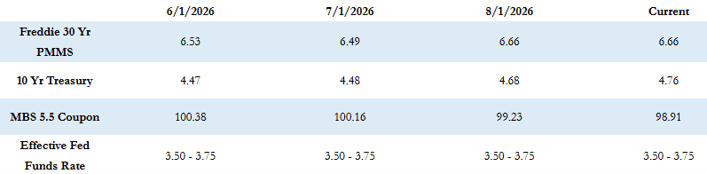
Mortgage rates remained relatively steady last week but continue to sit at elevated levels, with the Freddie Mac average 30-year fixed mortgage rate at 6.66%. Meanwhile, the 10-year Treasury yield closed the week at 4.72%, while persistent inflation, economic growth, Federal Reserve policy expectations, and ongoing geopolitical tensions continue to influence mortgage and bond markets. The latest PCE inflation data came in slightly higher than expected, while Q2 GDP growth remained resilient at 1.5%. Markets are now closely watching August employment data and upcoming Federal Reserve developments for clues about the direction of interest rates through the remainder of 2026.
Here’s a look at this week’s update on the major bond market indices, scheduled Federal Reserve meetings, upcoming market-moving economic data releases, and general bond market trends.
Bond Market Indices
“Combined with other recent economic data releases last week’s data painted a picture of a resilient economy although pricing pressures remain a threat.”
Market Overview and Rate Trends
Mortgage rates were little changed last week but remain elevated. The Freddie Mac average 30-year fixed rate is at 6.66% as of last Thursday and was up slightly by 1 basis point compared to the prior week. That puts the maximum APR this week for 30-year fixed-rate loans at roughly 8.16% (6.66 + 1.50).
The 10-year Treasury yield closed last week at 4.72%, which was down slightly by 1 basis point for the week.
Inflation and Economic Growth
Last week we saw fresh inflation data with the release of the latest PCE index. The inflation index came in at 3.7% year over year, which was slightly higher than the expectation of 3.6%.
The new inflation data is another reminder that inflationary pressures persist, driven by high and volatile oil prices.
Also last week, the Q2 GDP data was released, showing growth of 1.5%, which was right in line with the market expectation. Combined with other recent economic data releases, last week’s data painted a picture of a resilient economy, although pricing pressures remain a threat.
Federal Reserve Outlook
On Friday, Fed Chairman Warsh spoke at the Fed’s Jackson Hole Economic Symposium, and his speech was very hawkish, emphasizing the committee’s focus on driving inflation back down to its 2% target and using rate hikes as the primary mechanism to do so.
He also reiterated that the Fed should not be in the business of providing forward guidance in the markets, which is a shift in Fed policy that he implemented when he took over in May.
Current odds for a rate hike at the September FOMC meeting are at about 50%, but the most likely case is that they hold firm in September. By the October FOMC meeting, the odds for a rate hike increase to about 75%, but there is growing optimism that the Fed will keep its benchmark rate unchanged throughout the end of the year.
The war in Iran continues to be a key driver in the direction of the financial markets, and volatility will remain in the markets until geopolitical tensions ease and energy prices stabilize.
Economic Calendar and Market Drivers
This week, the focus will be on August’s employment data, with the ADP and the official U.S. report due this week.
Last month, the July jobs report disappointed sharply to the downside, and the expectation is for a bounce back in August with 50K jobs created.
There are a few Federal Reserve governors speaking on Wednesday, but aside from the employment data, the economic calendar is fairly light.
Current Market Conditions
MBS prices are down slightly by about 10–15 basis points compared to where they closed on Friday, and the 10-year Treasury is up a few basis points to 4.76%.
Looking Ahead
Mortgage and bond markets will continue to respond to inflation data, economic growth, employment conditions, Federal Reserve policy expectations, energy prices, and geopolitical developments. With August employment data taking center stage this week, investors will be watching closely for additional clues about the potential path of interest rates.
As markets continue to navigate changing economic conditions and ongoing volatility, homebuyers, homeowners, and real estate professionals should keep their focus on the broader trends rather than reacting to any single day’s market movement.
Stay tuned each week for the latest economic data, Federal Reserve developments, bond market trends, and mortgage market insights shaping the housing market.


