



Insights and Analysis: Mortgage and Real Estate Capital Markets Update with Jeff Rosato, SVP of Capital Markets at NMB NOW.
Key Takeaways
Mortgage rates have eased slightly following a recent bond market rally, with the Freddie Mac average 30-year fixed mortgage rate declining to 7.32%. The 10-Year Treasury yield has also moved lower, closing at approximately 4.99%, providing some relief after a period of rising rates. However, elevated mortgage rates, persistent inflation, wage pressures, and ongoing economic uncertainty continue to shape the market outlook. The Federal Reserve’s upcoming policy decision and key economic releases, including third-quarter GDP, personal income and spending, and the Personal Consumption Expenditures (PCE) Price Index, will provide important signals about the direction of monetary policy. While futures markets currently reflect an elevated probability of a December rate increase, the outlook remains dependent on incoming economic data. Meanwhile, housing affordability challenges persist, and potential federal measures aimed at reducing housing costs could affect financing expenses over time, although implementation and timing remain uncertain.
Here’s a look at this week’s update on the major bond market indices, scheduled Federal Reserve meetings, upcoming market-moving economic data releases, and general bond market trends.
Bond Market Indices
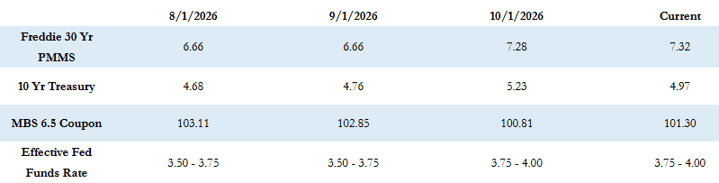
“The Federal Reserve also will have their October FOMC meeting this week with the rate decision expected at 2:00 on Wednesday…It’s widely expected that they will leave the benchmark Fed Funds rate steady in the 3.75-4.25% range that it has been at since the last .25% hike in September.”
Mortgage Rate and Treasury Market Trends
The bond markets provided some relief during the latest reporting period, and mortgage rates declined slightly from the highs seen earlier in the month.
The Freddie Mac average 30-year fixed mortgage rate stands at 7.32%, down 8 basis points from the previous week. Since the beginning of September, the index had increased by approximately 0.75 percentage points, rising from 6.66% to a recent high of 7.40%. The latest market rally has allowed rates to ease to 7.32%. Based on this average rate, the maximum APR for 30-year fixed-rate loans this week is approximately 8.82% (7.32% + 1.50%).
The 10-Year Treasury yield closed the latest reporting period at approximately 4.99%, down 11 basis points for the week. These movements offer some relief following the sharp increase in rates over the preceding weeks, although the broader interest rate environment remains challenging.
Housing Affordability and Market Conditions
Elevated mortgage rates and high home prices continue to create significant affordability challenges for prospective homebuyers. Mortgage applications for both purchases and refinances have been declining, alongside pending home sales and new housing starts.
Expectations surrounding Federal Reserve policy continue to be shaped by persistent inflation and wage pressures, reinforcing the market’s expectation that rates may remain higher for longer.
The recent bond market rally was not driven by a fundamental change in inflation expectations or a clear weakening in U.S. economic conditions. Instead, other factors, including weakness in the stock markets and safe-haven demand amid a dynamic geopolitical environment, contributed to the move.
The federal government has also introduced measures intended to reduce housing costs through a variety of approaches, including potentially reducing certain loan-level pricing adjustments. Over time, these measures could help reduce financing costs, but their timing, implementation, and ultimate impact remain uncertain.
Economic Data and Federal Reserve Outlook
The latest reporting period was relatively light in terms of economic data releases, but the upcoming calendar includes several potentially market-moving reports.
Housing data, including the Case-Shiller Home Price Index and New Home Sales, will provide additional insight into current market conditions. Later in the week, the first estimate of third-quarter gross domestic product (GDP), Personal Income and Spending, and the Personal Consumption Expenditures (PCE) Price Index are scheduled for release. The PCE Index is the Federal Reserve’s preferred gauge of inflation.
The Federal Open Market Committee (FOMC) is also scheduled to announce its latest policy decision. Market participants will closely examine the committee’s statement for clues about its interest rate strategy and the outlook for future policy changes.
The market widely expects the Federal Reserve to leave the benchmark federal funds rate unchanged within the 3.75%–4.00% range established following the September rate increase of 0.25 percentage points. However, federal funds futures markets are currently pricing in approximately an 80% probability of another 0.25-percentage-point rate increase at the December FOMC meeting.
Much can change between now and December. Weakening economic conditions, labor market softness, a slowing housing market, and evolving inflation expectations could all influence the Federal Reserve’s decisions and shift market expectations.
The Fed remains dependent on incoming data to shape its strategy. With a significant volume of economic releases and an FOMC policy decision on the calendar, volatility in Treasury and mortgage rate markets remains a key consideration.
Bond Market Outlook
Recent bond market movements have provided some relief, but the broader outlook remains uncertain. Mortgage-backed securities (MBS) prices were generally flat compared with their most recent close, while the 10-Year Treasury yield declined a few basis points to approximately 4.97% at the time of the update.
Market participants will continue monitoring inflation data, employment trends, economic growth, and Federal Reserve communications for signals about the direction of interest rates. These factors will remain central to mortgage pricing and market volatility in the weeks ahead.
Looking Ahead
Mortgage rates and Treasury yields remain sensitive to inflation trends, labor market conditions, economic growth, geopolitical developments, and expectations for Federal Reserve policy. Although the recent bond market rally has provided modest relief, affordability challenges and the possibility of further rate increases continue to shape the mortgage landscape.
Stay tuned for next week’s market update for the latest insights into mortgage rates, bond market trends, Federal Reserve policy, and the economic developments influencing the mortgage and real estate markets.