



Insights and Analysis: Mortgage and Real Estate Capital Markets Update with Jeff Rosato, SVP of Capital Markets at NMB NOW.
Key Takeaways
Mortgage rates declined to 7.11%, while the 10-Year Treasury yield climbed to approximately 5.15% following a significant bond market selloff triggered by stronger-than-expected October inflation data. Markets are now pricing in a 90% chance of a Federal Reserve rate hike in December, with a 0.50-percentage-point increase also as a possibility. Upcoming economic reports and Fed commentary will be key indicators in determining the direction of mortgage rates as market volatility continues.
Here’s a look at this week’s update on the major bond market indices, scheduled Federal Reserve meetings, upcoming market-moving economic data releases, and general bond market trends.
Bond Market Indices
“Currently the expectation of a .25% rate hike in December is almost a certainty, with the futures markets pricing in about a 90% chance. Since last week the odds of a .50% hike have increased to about 10%.”
Mortgage Rate and Treasury Market Trends
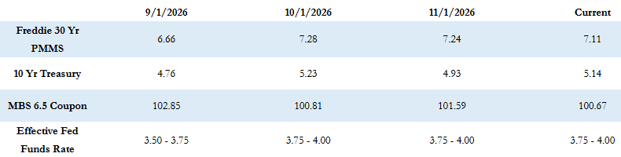
The Freddie Mac average 30-year fixed mortgage rate is at 7.11% according to the latest reporting, down sharply by 7 basis points compared to the prior week. However, the bond market sold off sharply during the latest reporting period, so average mortgage rates are higher than the index would indicate.
Mortgage rates have been very volatile over the last month and a half. For reference, the PMMS was at 6.71% at the beginning of September, meaning rates have increased by approximately 0.40 percentage points since then. Based on the current average rate, the maximum APR for 30-year fixed-rate loans this week is approximately 8.61% (7.11% + 1.50%). The 10-Year Treasury yield closed the latest reporting period at 5.15%, up sharply by 29 basis points for the week.
Bond Market Activity and Economic Influences
After rallying through the beginning of November, Treasuries and mortgage-backed securities (MBS) sold off sharply during the latest reporting period. The October Consumer Price Index (CPI) was released and exceeded expectations. The headline number came in at +0.4% versus the expectation of +0.3%. While this was only a small amount higher than expected, combined with recent Federal Reserve commentary, it was enough to spark a significant selloff.
Federal Reserve Governor Christopher Waller gave a speech earlier in the week in which he stated that if October inflation data exceeded expectations, he would support calls for a 0.50% rate hike at the December FOMC meeting. Once the report was released, the selloff began. Waller is considered a more dovish Federal Reserve governor, meaning he is usually less supportive of rate hikes. As a result, his comments were taken as a stark caution to the markets that the Fed’s fight against inflation is not over.
Geopolitical tensions with Iran, oil price volatility, and weakness in the technology sector of the stock markets have all continued to add uncertainty to the markets. Because U.S. economic growth and the U.S. consumer remain resilient, the Federal Reserve sees the risks of persistent inflation outweighing the risks to economic growth that would come with further rate hikes.
Economic Data and Federal Reserve Interest Rate Outlook
Current market expectations indicate that a 0.25-percentage-point rate hike in December is almost a certainty, with futures markets pricing in approximately a 90% chance. The odds of a larger 0.50-percentage-point increase have also increased to approximately 10%.
This week’s economic calendar includes several important releases that could influence the direction of the bond markets. Retail Sales data will provide insight into consumer spending and the overall strength of the U.S. economy, while the minutes from the Federal Reserve’s October meeting will offer additional insight into policymakers’ discussions surrounding inflation, economic growth, and future interest rate decisions. The University of Michigan Consumer Survey will provide an indication of consumer sentiment and inflation expectations. Housing market data will also be important, including the NAHB Housing Market Index, which measures homebuilder confidence, Housing Starts, which tracks new residential construction activity, and Pending Home Sales, which offers an indication of future existing-home sales activity.
Along with the FOMC minutes, there is plenty of Federal Reserve commentary scheduled, with Fed speeches taking place throughout the week, including Federal Reserve Chairman Warsh speaking. The details of the FOMC minutes, as well as the scheduled Federal Reserve speeches, will likely influence market expectations and help drive the direction of the bond markets.
Bond Market Outlook
Mortgage-backed securities (MBS) prices are generally flat compared to their most recent close, while the 10-Year Treasury yield has declined slightly by 1 basis point to approximately 5.14%. After the significant selloff in Treasuries and MBS, investors will be closely monitoring upcoming economic data and Federal Reserve commentary for additional signals regarding inflation and the potential direction of interest rates.
The possibility of a December rate increase, particularly a larger-than-expected increase, remains a major concern for the bond markets. Persistent inflation, resilient consumer spending, geopolitical tensions, oil price volatility, and uncertainty in the stock markets will continue to contribute to market volatility.
Looking Ahead
The bond markets are facing renewed pressure following stronger-than-expected inflation data, and the possibility of another Federal Reserve rate increase in December has become increasingly likely. With market expectations pointing to a 90% chance of a 0.25-percentage-point increase and a growing possibility of a larger adjustment, upcoming economic reports and Federal Reserve commentary will be critical in determining the direction of mortgage rates.
As inflation, economic resilience, and geopolitical uncertainty continue to influence Treasury yields and mortgage-backed securities, staying informed on the factors driving mortgage pricing is essential for navigating changing market conditions.
We’ll see you next week for Jeff Rosato’s weekly market analysis for timely insight into the economic data, bond market movements, and Federal Reserve policy decisions shaping mortgage rates, housing affordability, and the real estate industry.


