



Insights and Analysis: Mortgage and Real Estate Capital Markets Update with Jeff Rosato, SVP of Capital Markets at NMB Now.
Key Takeaways
Mortgage rates reached their highest levels of 2026 last week as Treasury yields continued to climb amid renewed geopolitical tensions in the Middle East and elevated oil prices. Investors are now focused on this week’s Federal Open Market Committee (FOMC) meeting, along with several key economic reports—including the PCE Index, second-quarter GDP, consumer income and spending, and consumer confidence—that could influence the outlook for inflation, interest rates, and the mortgage market.
Here’s a look at this week’s update on the major bond market indices, scheduled Federal Reserve meetings, upcoming market-moving economic data releases, and general bond market trends.
Bond Market Indices
“Markets continue to be driven by geopolitical developments in the Middle East and oil prices, with other positive economic fundamentals being overlooked.”
Market Overview and Rate Trends
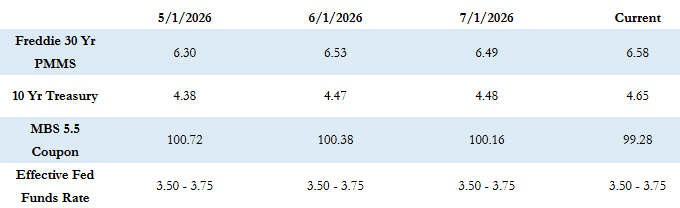
The Freddie Mac average 30-year fixed mortgage rate is 6.58% as of last Thursday, up 3 basis points compared to the prior week. Based on that average, the maximum Annual Percentage Rate (APR) for a 30-year fixed-rate loan is approximately 8.08% (6.58% + 1.50%).
The 10-year Treasury yield closed last week at 4.68%, increasing sharply by 14 basis points for the week.
Bond yields continued to climb throughout last week, and mortgage rates reached their highest levels of 2026. In fact, mortgage rates are at their highest levels since last August, with the Freddie Mac Primary Mortgage Market Survey (PMMS) at 6.58%.
Inflation, Geopolitics, and Federal Reserve Outlook
Renewed tensions in the Middle East have created fresh volatility in the markets, and high oil prices are stoking inflationary pressures. Recent data has shown that price pressures are gradually moderating, but the markets remain skeptical that higher oil prices due to the war in Iran will spill over into broader inflation expectations.
Last week was very light in terms of fresh economic data, but this week will be much busier. Inflation data in the form of the Personal Consumption Expenditures (PCE) Index is due out on Thursday, and several key economic reports will be released, including second-quarter GDP, consumer income and spending, and consumer confidence.
The biggest story this week, however, will be the July FOMC meeting and the committee’s interest rate decision. It is widely expected that the Federal Reserve will leave rates unchanged. However, the odds of a 0.25% rate hike this week have quietly increased to about 30%. While a rate increase appears unlikely given the current environment, it is not out of the question.
The odds for a 0.25% rate cut at the September FOMC meeting remain much higher, with futures markets currently pricing at approximately a 65% probability. The Federal Reserve is expected to remain cautious as inflation risks remain elevated due to high oil prices.
The markets remain driven by geopolitical developments in the Middle East and oil prices, while other positive economic fundamentals are being overlooked. Volatility is expected to remain elevated until geopolitical tensions ease and energy prices stabilize.
Economic Calendar and Market Drivers
This week’s economic calendar is packed with market-moving events. Investors will closely watch the FOMC interest rate decision, followed by the release of the PCE Index, the Federal Reserve’s preferred measure of inflation.
Additional reports on second-quarter GDP, consumer income and spending, and consumer confidence will also provide insight into the strength of the U.S. economy and may influence expectations for future Federal Reserve policy.
Current Market Conditions
MBS prices are up slightly by about 5 to 10 basis points compared to where they closed on Friday, and the 10-year Treasury yield is down a few basis points to 4.65%.
Looking Ahead
Markets will continue to monitor geopolitical developments, energy prices, inflation data, and the Federal Reserve’s policy decisions as investors assess the direction of interest rates in the months ahead.
Stay tuned next week for another market update as we continue tracking the economic trends, bond markets, and mortgage rate movements impacting homebuyers, homeowners, and real estate professionals.


