


Insights and Analysis: Mortgage and Real Estate Capital Markets Update with Jeff Rosato, SVP of Capital Markets at NMB NOW.
Key Takeaways
Mortgage rates remain elevated, with the Freddie Mac average 30-year fixed mortgage rate reaching 7.40%, its highest level since November 2023. Although recent bond market activity has provided some relief, persistent inflation, elevated oil prices, and stronger-than-expected consumer price data continue to support the possibility of additional Federal Reserve rate hikes. Current market expectations point to a high probability of a quarter-point rate increase in December, while the likelihood of an increase at the upcoming October meeting remains lower. At the same time, signs of weakening economic conditions and reduced consumer resilience are adding uncertainty to the outlook.
Here’s a look at this week’s update on the major bond market indices, scheduled Federal Reserve meetings, upcoming market-moving economic data releases, and general bond market trends.
Bond Market Indices
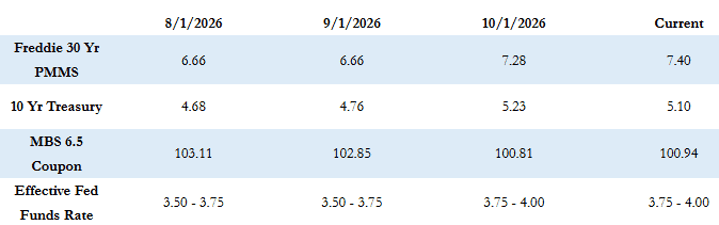
“The data supports the case for further Fed tightening with the odds of a .25% rate hike in December currently at about 90%. A rate hike at the Oct 28th meeting remains unlikely, however the Fed futures market still shows about a 15% chance of an October hike.”
Mortgage Rate and Treasury Market Trends
Mortgage rates have remained elevated through the end of September and into October, reaching their highest levels since November 2023. However, a modest bond market rally toward the end of the latest reporting period helped average mortgage rates finish relatively flat. The Freddie Mac average 30-year fixed mortgage rate stands at 7.40%, unchanged from the previous reporting period.
Since the beginning of September, the index has increased by 0.74 percentage points, rising from 6.66%. This represents a significant move over a relatively short period, although the latest reporting period marked the first time since early August that the index did not increase. Based on the current average rate, the maximum APR for 30-year fixed-rate loans this week is approximately 8.90% (7.40% + 1.50%).
The 10-Year Treasury yield closed at 5.10%, down sharply by 14 basis points over the latest reporting period. Rates have risen dramatically in a short period of time, creating challenges for mortgage pricing.
Inflation Data and Federal Reserve Outlook
Recent economic releases have reinforced concerns that inflation remains stubbornly elevated. The Consumer Price Index (CPI) and Producer Price Index (PPI) both came in hotter than expected, with year-over-year CPI increasing by 3.7%.
Sustained elevated energy prices, with oil hovering around $100 per barrel, continue to push inflation higher and support the view that price pressures remain above the Federal Reserve’s 2% target.
Despite the hotter-than-expected inflation data, bond markets experienced a flight-to-quality rally as stock markets sold off during the latest reporting period. As a result, the inflation releases did not trigger the bond market selloff that might otherwise have been expected.
Nevertheless, inflation remains persistent and elevated, while emerging signs of a weakening U.S. economy and declining consumer resilience suggest that higher prices are beginning to take a greater toll.
The data supports the case for further Federal Reserve tightening. Current futures market expectations indicate approximately a 90% probability of a quarter-point rate hike in December. A rate increase at the upcoming October meeting remains unlikely, although futures markets continue to reflect approximately a 15% chance of an increase.
The Federal Reserve’s next moves will depend on incoming economic data and how policymakers balance persistent inflation against signs of weakening economic conditions.
Housing Affordability and Mortgage Market Conditions
The current interest rate environment continues to create challenges for borrowers and lenders. Total mortgage applications have declined by approximately 6% week over week, while refinance activity remains down more than 50% compared with the same period a year ago.
Elevated home prices, combined with higher mortgage rates, continue to create significant affordability challenges for prospective homebuyers. Existing homeowners considering refinancing are also facing a less favorable borrowing environment, particularly when compared with the lower-rate opportunities available in previous years.
For loan officers and real estate professionals, these conditions underscore the importance of setting realistic borrower expectations, understanding current financing options, and maintaining proactive communication throughout the mortgage process.
Economic Calendar and Bond Market Outlook
The upcoming economic calendar is relatively light, although housing market data will provide additional insight into current conditions. The University of Michigan consumer survey is also expected to offer a useful indication of consumer resilience in the face of elevated prices.
Recent bond market movements suggest that volatility remains a key consideration. Mortgage-backed securities (MBS) prices are down approximately 25 basis points compared with their most recent close, while the 10-Year Treasury yield has increased several basis points to approximately 5.15%.
Looking Ahead
Mortgage rates and Treasury yields remain sensitive to persistent inflation, elevated energy prices, changing economic conditions, and expectations for further Federal Reserve tightening. While recent bond market activity has provided some relief, the broader outlook remains uncertain, and the possibility of additional rate increases continues to influence mortgage pricing.
Stay tuned for next week’s market update for the latest insights into mortgage rates, bond market trends, Federal Reserve policy, and the economic developments shaping the mortgage and real estate markets.