



Insights and Analysis: Mortgage and Real Estate Capital Markets Update with Jeff Rosato, SVP of Capital Markets at NMB NOW.
Key Takeaways
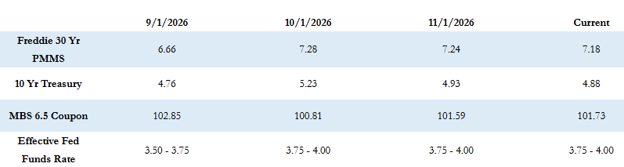
Mortgage rates continued to ease, with the Freddie Mac 30-year fixed mortgage rate declining to 7.18% and the 10-Year Treasury yield falling to approximately 4.88%. Despite recent improvements in the bond markets, strong employment data, persistent inflation above the Federal Reserve’s 2% target, and continued economic resilience have increased the likelihood of another federal funds rate hike in December, with current market expectations approaching 80%. This week’s primary economic focus is the October Consumer Price Index (CPI) report, which will provide additional insight into inflation trends and the potential direction of mortgage rates. Meanwhile, volatility in the stock market, geopolitical developments, and widening spreads between Treasuries and mortgage-backed securities continue to influence mortgage pricing and the broader housing market.
Here’s a look at this week’s update on the major bond market indices, scheduled Federal Reserve meetings, upcoming market-moving economic data releases, and general bond market trends.
Bond Market Indices
“This week the economic calendar is fairly light, but the highlight will be the October CPI report being released. CPI surprised to the upside in September, so it’ll be interesting to see if that trend continued in October.”
Mortgage Rate and Treasury Market Trends
The Freddie Mac average 30-year fixed mortgage rate stands at 7.18%, down 6 basis points compared to the previous week. Although mortgage rates have decreased from their recent highs over the last few weeks, the PMMS at 7.18% is still approximately 0.45 percentage points higher than where rates were at the beginning of September.
Based on the current average rate, the maximum APR for 30-year fixed-rate loans this week is approximately 8.68% (7.18% + 1.50%).
The 10-Year Treasury yield closed the latest reporting period at 4.86%, down 7 basis points for the week. Current market activity shows the 10-Year Treasury yield at approximately 4.88%.
Bond Market Activity and Economic Influences
The bond markets continued to rally over the latest reporting period. Following the midterm elections, political uncertainty eased, providing some support for the markets. However, with politically divided executive and legislative branches, passing new legislation over the next two years could prove difficult.
Oil prices have also continued to decline amid cautious optimism surrounding a potential resolution to the conflict with Iran, easing some geopolitical concerns.
Meanwhile, stock market volatility has remained elevated, particularly among technology stocks and AI companies. This volatility has contributed to increased safe-haven demand for U.S. Treasuries, pushing the 10-Year Treasury yield lower.
However, despite the strong rally in Treasuries, spreads between Treasuries and mortgage-backed securities (MBS) have widened. This means average mortgage rates and pricing have not improved to the same extent as Treasury yields. It serves as an important reminder that mortgage rates do not always move in direct correlation with the 10-Year Treasury.
Economic Data and Federal Reserve Interest Rate Outlook
Recent economic data showed continued strength in the labor market. The October employment report showed the addition of 165,000 jobs, significantly exceeding expectations of 59,000. The unemployment rate also declined slightly to 4.1% from 4.2%.
Initial jobless claims declined, job openings continued to rise, and manufacturing numbers remained strong.
This stronger-than-expected economic data leaves the door open for the Federal Reserve to consider additional interest rate increases at its upcoming policy meetings, particularly as inflation remains elevated above its 2% target.
Current market expectations are pricing in approximately an 80% chance of a 0.25-percentage-point rate increase at the December 9 FOMC meeting.
The primary focus of this week’s economic calendar is the October Consumer Price Index (CPI) report. Inflation came in higher than expected in September, making the October report particularly important in determining whether those inflationary pressures are continuing.
Even if this week’s inflation data shows some easing, a December rate increase will likely remain a strong possibility given the continued strength of the economy and labor market.
Several Federal Reserve officials are also scheduled to speak, and their commentary could influence market expectations and contribute to additional volatility.
Financial markets will observe Veterans Day, with a full market closure scheduled for the holiday.
Bond Market Outlook
Mortgage-backed securities (MBS) prices are currently down approximately 5–10 basis points compared to their most recent close, while the 10-Year Treasury yield has increased slightly to approximately 4.88%.
Although the broader bond market has shown improvement in recent weeks, the relationship between Treasury yields and MBS pricing remains an important factor influencing mortgage rates. Widening spreads have limited the improvement in mortgage pricing relative to Treasury market movements.
Investors will continue monitoring inflation data, employment conditions, Federal Reserve communications, geopolitical developments, and stock market volatility for signals about the direction of interest rates.
The October CPI report will be particularly important in shaping expectations for the Federal Reserve’s next policy decision and the potential direction of mortgage rates heading into the end of the year.
Looking Ahead
Mortgage rates have continued to ease from their recent highs, but strong economic data, persistent inflation, and the possibility of another Federal Reserve rate increase in December continue to create uncertainty for the mortgage and real estate markets. The upcoming October CPI report will be a key indicator in determining whether inflationary pressures are beginning to moderate or whether additional monetary tightening may be necessary.
As the bond markets respond to new economic data and changing market conditions, understanding the relationship between Treasury yields, mortgage-backed securities, and Federal Reserve policy remains essential to navigating mortgage rate movements and housing affordability.
Stay informed with NMBNOW® and Jeff Rosato’s weekly market analysis for expert insight into the economic developments, bond market trends, and Federal Reserve decisions shaping mortgage rates and the real estate industry.


